

Key Takeaways
Choosing between electrolysis and laser hair removal comes down to your hair colour, skin tone, budget, and the area you want treated. Both are effective — but they work in completely different ways, and the “right” choice is rarely the same for two people. Here’s what every Durham Region reader should walk away knowing.
- Electrolysis is the only method the FDA recognizes as permanent — it destroys each follicle’s growth cells one at a time, so treated hair is gone for good.
- Laser delivers permanent hair reduction, not total removal — expect a large, lasting decrease in 6 to 8 sessions, usually with light maintenance over time.
- Your colouring is the deciding factor — laser works best on dark hair, while electrolysis works on every hair colour and skin tone, including grey, red, and blonde hair that laser can’t target.
- Cost depends on area, not just method — laser is more economical for large areas like legs and backs, while electrolysis often wins for small, stubborn spots like the upper lip or a few chin hairs.
- Modern laser is safe for darker skin tones — Nd:YAG wavelengths let experienced clinics treat richly pigmented skin that older machines couldn’t.
- Comfort is comparable — laser rates roughly 1–5 out of 10 for discomfort (lower with cooling), and electrolysis about 3–6 out of 10, depending on the area.
Read on for a clear, side-by-side breakdown, then book a free consultation to find out which method fits your goals.
Understanding the differences between electrolysis vs laser hair removal can help you make an informed decision.
Introduction
You’ve shaved, waxed, plucked, and threaded for years — and the hair keeps coming back. At some point, most people ask the same question: what if I never had to deal with this again?
That’s usually the moment the research begins. And within about five minutes, you hit a fork in the road: electrolysis vs laser hair removal?
Both promise long-term results. Both are done in a clinic. But they use entirely different technology, cost different amounts, and — this is the part most articles gloss over — they suit different people. The best method for your friend with dark, coarse leg hair may be the wrong one for your fine, light-coloured upper-lip hair.
Getting this decision right matters, because permanent hair removal is an investment of both time and money. Choosing the wrong method can mean paying for sessions that were never going to work well for your hair or skin in the first place.
Here’s what you’ll learn in this guide:
- How each method actually works — in plain language, no biology degree required
- Which one is truly permanent — and what “permanent reduction” really means
- What you’ll pay in 2026 — real Canadian pricing by treatment area
- How many sessions to expect — and how long the whole process takes
- Which method suits your skin tone and hair colour — the factor that decides it for most people
At Elegancy Beauty Bar in Ajax, we offer both laser hair removal and electrolysis, so we have no reason to push you toward one over the other. Our only goal is matching you with the method that gives you the smoothest result for your skin.
Electrolysis vs Laser Hair Removal: At a Glance
The quick side-by-side, before we dig into the details
| Factor | Electrolysis | Laser Hair Removal |
|---|---|---|
| How it works | One follicle at a time, with a fine probe | Many follicles at once, with pulses of light |
| Permanence | Permanent removal — the only FDA-recognized method | Permanent reduction — a major, lasting decrease |
| Best hair colour | Every colour — grey, red & blonde included | Dark hair (needs pigment contrast) |
| Skin tones | All skin tones | All skin tones with modern Nd:YAG technology |
| Ideal areas | Small, precise spots — lip, chin, brows | Large areas — legs, back, Brazilian |
| Sessions | Many, weekly or biweekly over a year+ | 6–8, spaced 4–8 weeks apart |
| Comfort (1–10) | About 3–6 | About 1–5 (lower with cooling) |
Let’s start with what’s actually happening beneath the surface.
How Electrolysis and Laser Hair Removal Actually Work
The biggest difference between these two treatments isn’t price or pain — it’s the mechanism. Understanding how each one removes hair explains everything else about them.
Electrolysis: one follicle at a time
Electrolysis uses a fine probe inserted into each individual hair follicle. A small current then destroys the follicle’s growth centre so it can never produce hair again.
Because it treats one follicle per insertion, electrolysis is precise and thorough. Nothing is left to chance — every follicle is dealt with directly.
That precision is also why it takes longer. There are no shortcuts when you’re working hair by hair.
Laser: many follicles at once
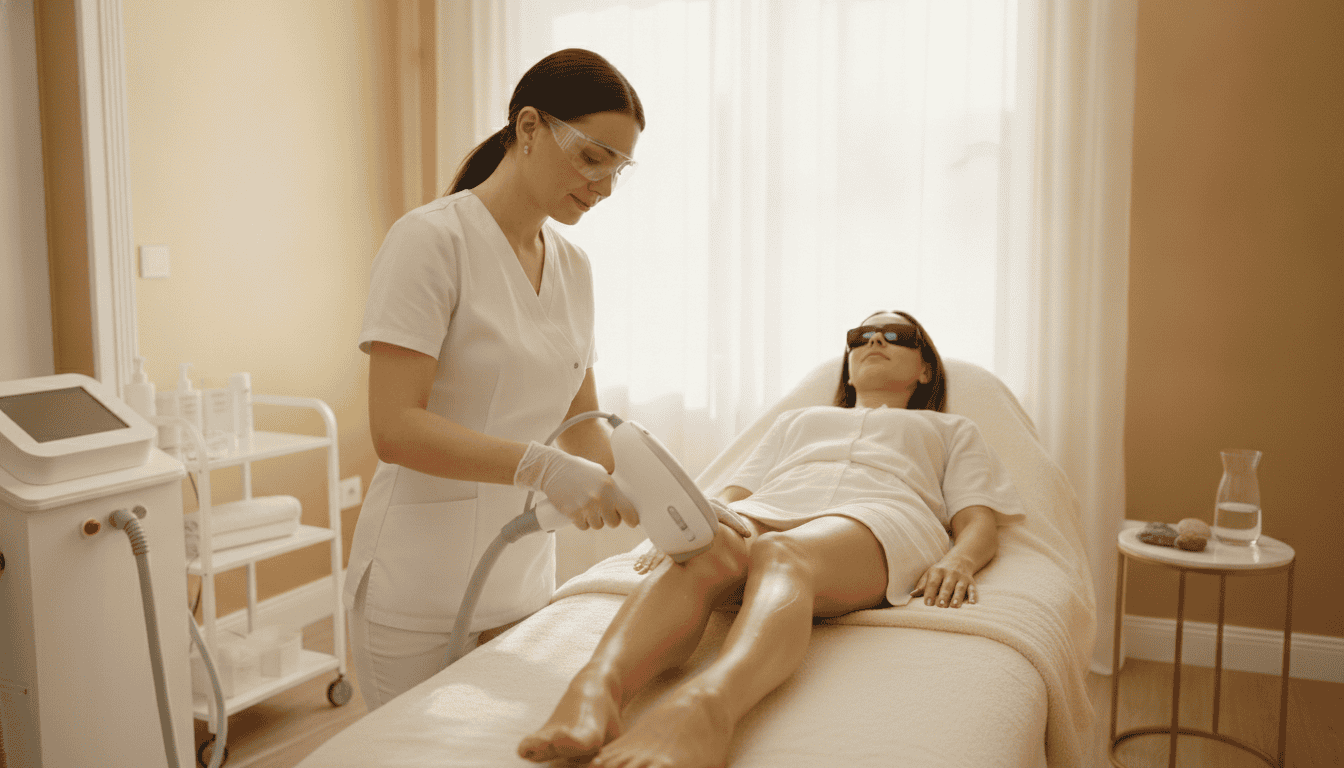
Laser hair removal works on a completely different principle: selective photothermolysis. The laser emits light that’s absorbed by the pigment (melanin) in the hair, and that energy converts to heat, damaging the follicle.
Because a single pulse covers a patch of skin, laser treats hundreds of follicles in seconds. That’s what makes it so fast on large areas.
Electrolysis — one follicle at a time
A fine probe slides into each hair follicle, and a tiny current disables its growth centre — precise, thorough, and effective on any hair colour.
Laser — many follicles at once
A single pulse of light floods a patch of skin, and the pigment in dark hair absorbs it as heat — treating hundreds of follicles in seconds.
- Electrolysis targets the follicle structure — works regardless of hair colour
- Laser targets the follicle pigment — needs enough contrast to find the hair
Why the mechanism matters
This one distinction drives every practical difference that follows. Laser’s reliance on pigment is its greatest strength (speed) and its main limitation (it can’t “see” light hair). Electrolysis trades speed for universal effectiveness.
Bottom line: electrolysis destroys follicles individually, while laser disables many at once using pigment as a target — and that’s why they suit different hair types.
Permanence: Which Method Truly Lasts?
This is where the marketing gets confusing, so let’s be precise about the language.
Electrolysis: the only “permanent removal”
The U.S. FDA classifies electrolysis as permanent hair removal — the only method that earns that exact wording. Once a follicle’s growth cells are destroyed, that follicle is finished.
This is why electrolysis is the gold standard for areas where you want zero regrowth, ever.
Laser: “permanent reduction”
Laser hair removal is cleared for permanent hair reduction. That’s not marketing hedging — it’s an important distinction.
You can expect a dramatic, long-lasting decrease in hair, but not always total elimination. Some follicles recover over months or years, which is why many people return for occasional maintenance sessions.
- Electrolysis = permanent removal (follicle destroyed for good)
- Laser = permanent reduction (major decrease, light upkeep possible)
What this means for you
For a small, defined area you never want to think about again — a few chin hairs, the upper lip — electrolysis offers true finality.
For larger areas where a big reduction transforms your routine, laser delivers excellent results far faster, and a quick touch-up once in a while is a fair trade.
The takeaway: if “permanent” is non-negotiable, electrolysis is the technically permanent option; if a major, lasting reduction meets your goal, laser gets you there quickly.
Cost Comparison: What You’ll Actually Pay in 2026
Price is often the tipping point — but comparing a single electrolysis session to a single laser session is misleading. What matters is the total cost to finish the area.
Typical 2026 Greater Toronto Area ranges. Actual pricing varies by clinic, area size, and hair type — book a free consultation for an exact quote.
Electrolysis pricing
Electrolysis is usually billed per session or per hour, and cost scales with the size of the area:
- Upper lip or eyebrows: roughly $50–$75 per session
- Bikini line or underarms: roughly $75–$100
- Legs: roughly $100–$150
Because it treats hair individually, a complete plan can range from a few hundred dollars for a small area to a few thousand for larger ones.
Laser pricing
In the Greater Toronto Area, a single laser session commonly runs $60 to $180 depending on the area, with most Canadian pricing landing between $50 and $450.
Packages tell the real story:
- Brazilian (6–8 sessions): around $900–$1,400
- Full body: often $4,500–$9,600, depending on clinic and technology
Which is more cost-effective
The honest answer: it depends on the area.
- Large areas (legs, back, full body) → laser almost always wins on cost-per-result
- Small, stubborn areas (upper lip, stray chin or eyebrow hairs) → electrolysis is often more economical and truly final
Bottom line: don’t compare per-session prices — compare the total cost to fully treat your specific area, and the winner will usually be obvious.
Treatment Time, Sessions, and Commitment
Hair removal isn’t a one-and-done treatment either way — both work with your hair’s natural growth cycle. But the time commitment looks very different.
| What to expect | Laser | Electrolysis |
|---|---|---|
| Sessions needed | 6–8 | Many (varies by area) |
| Frequency | Every 4–8 weeks | Weekly or biweekly |
| Time per session | Minutes to under an hour | Longer — treated hair by hair |
| Full timeline | ~6 months to 1 year | A year or more |
Laser: fewer, faster sessions
Most people need 6 to 8 laser sessions, spaced 4 to 8 weeks apart. Each session is quick — underarms take minutes, larger areas under an hour.
That means a typical laser plan wraps up in roughly six months to a year, with the actual chair time being short.
Electrolysis: more sessions, longer window
Electrolysis requires many more appointments, often weekly or biweekly, sometimes over a year or more.
Two reasons for this:
- Each follicle is treated individually, so coverage takes longer
- Follicles must be caught in their active growth phase, requiring repeat visits
Matching the method to your patience
- Want results with the fewest visits? Laser is far more efficient.
- Treating a small area and prioritizing permanence over speed? Electrolysis is very manageable.
Consistency matters enormously for both. Skipping sessions lets follicles slip out of their treatable window and stretches your timeline.
The takeaway: laser is the clear choice when your schedule is tight, while electrolysis rewards patience with permanent results on smaller, targeted areas.
Pain, Comfort, and Recovery
“Does it hurt?” is one of the first questions we hear — and the honest answer is that both are very tolerable for most people.
How each one feels
- Laser is often described as a warm snap, like an elastic band against the skin. On a comfort scale it rates about 3–5 out of 10, dropping to 1–3 with integrated cooling.
- Electrolysis feels like a brief pinch or heat at each follicle, roughly 3–6 out of 10, depending on the area.
Comfort at a glance
Typical discomfort on a scale of 1 (barely felt) to 10 (very intense)
Sensitive zones — the upper lip, bikini line — feel more intense with either method, simply because the skin there has more nerve endings.
Recovery and aftercare
Downtime is minimal for both. You may notice temporary redness or slight swelling for a few hours to a day.
Simple aftercare protects your results:
- Avoid sun exposure and hot showers for 24–48 hours
- Skip harsh exfoliants and heavy sweating right after
- Follow your therapist’s specific guidance for your skin

Modern equipment and an experienced hand make a real difference in comfort — a skilled therapist adjusts settings to your skin and pain tolerance.
Bottom line: neither treatment should be genuinely painful in trained hands, and both let you return to your day almost immediately with only minor, short-lived redness.
Skin Tone and Hair Colour: The Deciding Factor for Many
For a lot of people, this section settles the debate before cost or convenience even come into play.
When laser is the better fit
Laser needs pigment contrast to work — ideally dark hair. If your hair is dark and coarse, laser is fast, effective, and economical.
Historically, laser struggled with darker skin because the light couldn’t tell hair pigment from skin pigment. That’s changed.
Modern Nd:YAG wavelengths safely treat darker skin tones, which is exactly why the right technology and a trained provider matter so much.

When electrolysis is the safer choice
Electrolysis doesn’t rely on pigment at all, so it works where laser can’t:
- Grey, white, red, or blonde hair that lasers can’t target
- All skin tones, with no contrast required
- Fine, light “peach fuzz” facial hair
The Elegancy difference
At Elegancy Beauty Bar, our laser technology is chosen to treat every skin tone safely, including richly pigmented skin that older systems couldn’t serve well.
And because we offer both laser and electrolysis, we can build a plan around your exact hair colour and skin — not around whatever single machine happens to be in the room.
The takeaway: dark hair usually points to laser, while light or grey hair — and any skin tone — makes electrolysis the reliable choice, and a clinic offering both can tailor the plan to you.
Choosing the Right Method — and the Right Clinic — in Durham Region
By now the pattern is clear: there’s no universal winner, only the right match for your hair, skin, area, and goals.
A simple way to decide
Which method is right for you?
Find the line that sounds most like you
What to look for in a provider
The clinic matters as much as the method. Look for:
- Certified, experienced therapists who assess your skin before treating
- Technology suited to your skin tone, especially for darker complexions
- Both treatment options available, so advice isn’t limited by equipment
- Strong local reputation and transparent, no-pressure consultations
Why Durham Region clients choose Elegancy
Elegancy Beauty Bar serves Ajax, Whitby, Pickering, Oshawa, and Bowmanville from our Bayly Street location, with a 4.9-star rating across 300+ reviews.
Our certified Beauty Therapists offer laser hair removal and electrolysis, tailored to every skin tone — and every plan starts with an honest conversation about what will actually work for you.
Bottom line: the smartest first step isn’t choosing a method on your own — it’s booking a consultation with a clinic that offers both and letting the results speak.
Conclusion
Smooth, low-maintenance skin is absolutely within reach — the key is matching the method to you rather than chasing whichever treatment happens to be trending.
Electrolysis and laser hair removal both work. One offers true permanence follicle by follicle; the other offers a dramatic, lasting reduction across large areas in just a handful of visits. Neither is “better” in a vacuum — they’re better for different people and different areas.
Here’s what to hold onto:
- Electrolysis is the only permanent removal and works on every hair colour and skin tone — ideal for small, stubborn, or light-haired areas.
- Laser is faster and more economical for large areas of dark hair, delivering permanent reduction in 6 to 8 sessions.
- Your hair colour and skin tone usually make the decision clearer than cost alone.
- The right clinic — one offering both methods and technology suited to your skin — turns a confusing choice into a simple one.
Your next step is easy: book a free consultation at Elegancy Beauty Bar. In a few minutes, a certified therapist can assess your hair and skin, answer your questions, and recommend the approach that gives you the best results — with no pressure and no guesswork.
You’ve spent enough years fighting regrowth. This is the year you stop shaving, plucking, and waxing on repeat — and start enjoying skin that finally stays smooth.