
How many laser hair removal sessions do you need? Most people need 6 to 8 laser hair removal sessions, spaced 4 to 10 weeks apart depending on the body area. Facial and hormone-driven hair often needs 8 to 10 or more. After the full course, most people book a maintenance session once or twice a year. At Elegancy Beauty Bar in Ajax, most clients need 6 to 8 sessions for a lasting reduction in hair growth.
Key takeaways
- Most people need 6 to 8 sessions. The American Academy of Dermatology puts the usual range at 2 to 6 treatments, and facial or hormone-driven hair can need 10 or more.
- Laser only destroys hairs in their growth (anagen) phase. Each session catches a different set of follicles, which is why one session is never enough.
- Space sessions 4 to 6 weeks apart on the face and 6 to 10 weeks apart on the body. Booking sooner does not speed things up, because the next set of hairs has not reached its growth phase yet.
- Legs respond best, and the face takes longest. A 2022 systematic review found the greatest long-term reduction on leg hair and the lowest on facial hair.
- Dark, coarse hair on any skin tone responds best. White, grey, light blonde and most red hair has too little pigment for laser, and electrolysis is the better option.
- Shave between sessions, but never wax or pluck. Waxing and plucking remove the root that the laser needs to target.
- Laser hair removal is a permanent reduction, not a guarantee of zero hair. Plan on one or two maintenance sessions a year, more if hormones are involved.
Why does laser hair removal take more than one session?
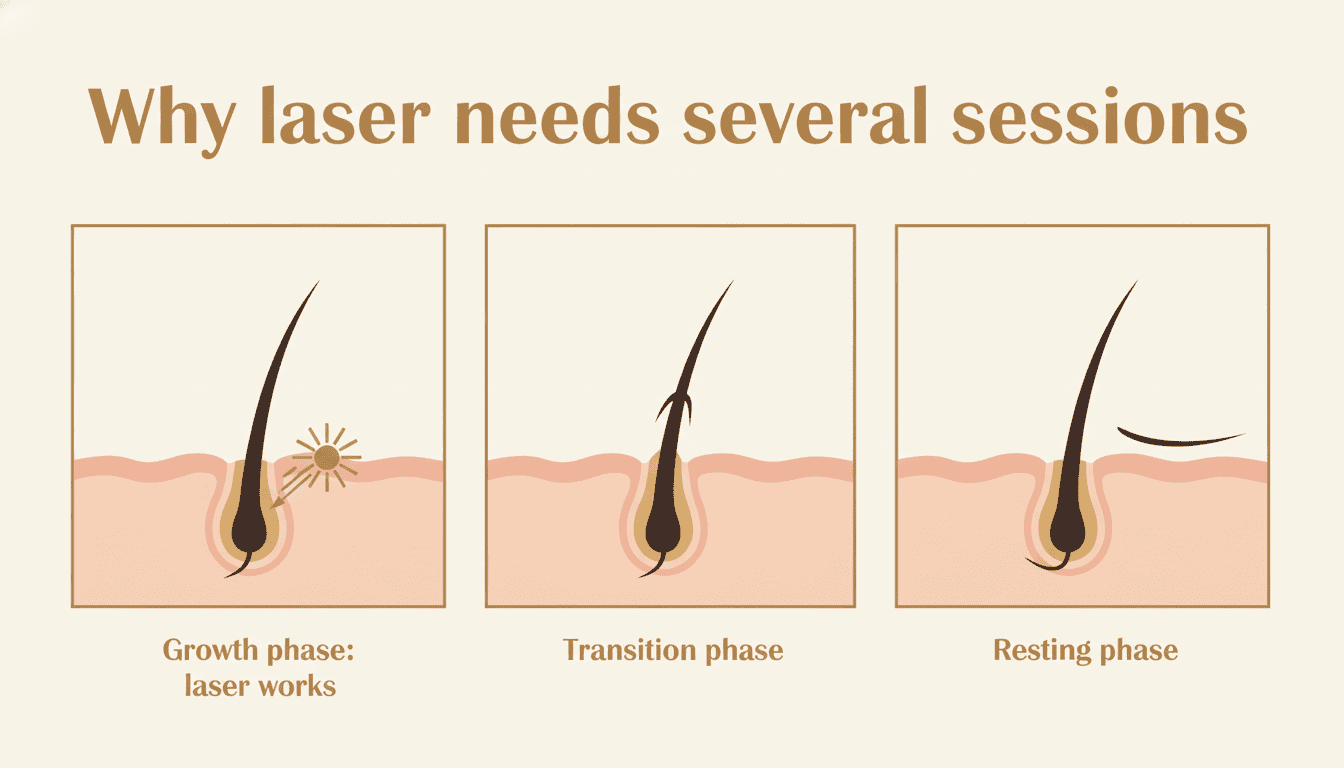
Laser hair removal takes several sessions because the laser can only destroy a hair follicle while that hair is in its active growth phase, called anagen. At any one time, only part of your hair is in anagen. The rest is in the transition (catagen) or resting (telogen) phase, and those hairs survive the session.
How the hair growth cycle works
Every hair follicle moves through three phases on its own schedule:
- Anagen (growth). The hair is attached to the follicle and full of pigment. The laser's energy travels down the pigment and heats the follicle. This is the only phase in which laser hair removal works.
- Catagen (transition). The hair detaches from its blood supply. The laser cannot reach the root.
- Telogen (rest). The old hair sheds and the follicle sits dormant. There is nothing for the laser to target.
Why spacing sessions out catches more hair
Each laser hair removal session treats the follicles that happen to be growing that day. A few weeks later, a new group of follicles has moved into the growth phase. The next session treats that group. Over 6 to 8 sessions, most follicles in the treatment area get caught in their growth phase at least once.
Health Canada's safety guidelines for laser hair removal clinics say the same thing: because hair grows in several phases, most people need repeated treatments to get good results.
How many laser hair removal sessions do you need for each body area?
Most body areas need 6 to 8 laser hair removal sessions. The face, back and chest often need more, because facial hair is often driven by hormones and back and chest hair is dense. The table below shows typical ranges. Your own number is set at your consultation, after your skin and hair are assessed.
Typical ranges from published dermatology and clinical guidance. They are not a promise. Hair colour, skin tone and hormones all change the number.
Laser hair removal sessions for the bikini and Brazilian area
The bikini line and Brazilian area usually need 6 to 8 laser hair removal sessions, spaced 6 to 8 weeks apart. Bikini hair is coarse and dark, so it responds well to laser. Dense Brazilian hair can need a session or two more than a simple bikini line. Elegancy Beauty Bar's guide to bikini line laser hair removal covers the bikini options in detail.
Laser hair removal sessions for the face
Facial laser hair removal often needs 8 to 10 sessions, and sometimes more. Facial hair is sensitive to hormones, especially on the upper lip, chin and jawline. A 2022 systematic review in the Journal of Cosmetic and Laser Therapy found the lowest long-term hair reduction on facial hair and the highest on leg hair, across Alexandrite, diode and Nd:YAG lasers.
How long should you wait between laser hair removal sessions?
Wait 4 to 6 weeks between laser hair removal sessions on the face and 6 to 10 weeks on the body. Facial hair cycles faster, so new follicles reach their growth phase sooner. Hair on the legs and back cycles more slowly, so those sessions are spaced further apart.
Why booking sooner does not speed things up
Booking laser sessions every 2 weeks does not shorten the course. The hairs that survived the last session are still resting or in transition, so the laser has nothing to target. Early sessions add heat and irritation to the skin without adding results.
What happens if you miss a laser session
A late laser session does not undo the follicles already treated. The next session simply treats whichever hairs are growing on that day. A long gap of several months can let more hair grow back, so it is worth rebooking as soon as you can.
How long each laser hair removal session takes
A single laser hair removal session takes about 15 to 60 minutes, depending on the size of the area. Small areas like the upper lip or underarms take under 20 minutes at Elegancy Beauty Bar. Elegancy's guide on how long laser hair removal takes breaks down the time per area.
What changes the number of laser hair removal sessions you need?
Five things change how many laser hair removal sessions you need: your hair colour and thickness, your skin tone, your hormones, the body area, and whether you keep to the schedule. Two people treating the same area can need very different numbers of sessions.
Hair colour and thickness
Laser hair removal works by targeting the pigment (melanin) in the hair. Dark, coarse hair absorbs the most energy and usually clears in fewer sessions. Fine or lighter brown hair often needs more. White, grey, light blonde and most red hair has too little pigment for laser to work. For those hair colours, electrolysis is the better option. Elegancy Beauty Bar offers both, and its comparison of electrolysis vs laser hair removal explains which suits which hair.
Skin tone
Skin tone changes which laser wavelength is safe, and it can add sessions. On deeper skin tones, the laser settings are adjusted so the skin's own pigment is protected, and gentler settings can mean an extra session or two. The American Academy of Dermatology notes that laser hair removal is now an option for people with dark skin, but it has to be performed carefully.
Hormones
Hormones keep switching on new hair follicles, so hormone-driven hair needs more sessions and more maintenance. Common causes include polycystic ovary syndrome (PCOS), pregnancy, menopause and some medications. If you have PCOS or another hormonal condition, expect 10 or more sessions on the face, and talk to your doctor about treating the cause as well.
Keeping to the schedule
Missed appointments and waxing between sessions both slow results. Waxing, plucking and threading pull out the root, and the root is what the laser needs to find. Health Canada's guidelines tell clinics to give clients pre-treatment instructions that rule out plucking, waxing, electrolysis and tanning.
Does laser hair removal take more sessions on darker skin?
Laser hair removal on darker skin can take a similar number of sessions or one or two more, because the settings are tuned for safety first. What matters most is the wavelength. The 1064 nm Nd:YAG laser passes through the skin's surface pigment more safely than shorter wavelengths, so it is the usual choice for Fitzpatrick skin types IV to VI.
What the research says about lasers on skin of colour
A 2020 meta-analysis in the Journal of the European Academy of Dermatology and Venereology compared lasers and intense pulsed light (IPL) on Fitzpatrick skin types III to VI. It found:
- Long-pulsed Nd:YAG laser caused less post-inflammatory hyperpigmentation (dark patches) than IPL.
- Alexandrite laser reduced hair count more than IPL.
- Results across devices were broadly similar, with a trend toward better hair reduction from lasers than from IPL.
How Elegancy Beauty Bar treats every skin tone
Elegancy Beauty Bar treats all skin tones, Fitzpatrick I to VI. The clinic uses the GentleMax Pro and Cynosure Elite+, which combine a 755 nm Alexandrite laser and a 1064 nm Nd:YAG laser. The wavelength and settings are matched to your skin type at your free consultation. Elegancy's guide to laser hair removal for Black skin explains the approach in more detail.
What results can you expect after each laser hair removal session?
Most people see some hair reduction after their first laser hair removal session, with treated hairs shedding over the following one to three weeks. Each session then thins the regrowth further. The regrowth that does come back is usually finer and lighter.
A session-by-session guide
- Sessions 1 and 2. Treated hairs shed. You shave less often, but new hairs from untreated follicles still appear.
- Sessions 3 to 5. Regrowth becomes visibly patchier, finer and slower.
- Sessions 6 to 8. Most people reach a lasting reduction in the area. A few stray hairs may remain.
- After the course. Occasional maintenance sessions clear any hair that new follicles produce.
How much hair reduction lasts long term
Long-term results depend on the laser and the body area. The 2022 Journal of Cosmetic and Laser Therapy review looked only at trials that followed patients for at least one full hair growth cycle. It reported these average long-term hair reductions:
Source: Krasniqi et al., Journal of Cosmetic and Laser Therapy, 2022. The highest figures for each laser came from leg hair and the lowest from facial hair.
Is laser hair removal permanent, or will you need maintenance sessions?
Laser hair removal gives a permanent reduction in hair, not a guarantee of permanent hair removal. The American Academy of Dermatology says most patients stay hair-free for months or even years, and some need maintenance treatments to keep the area clear. Electrolysis is the method that removes individual hairs permanently.
How often maintenance sessions are needed
Most people book one or two maintenance sessions a year after finishing their course. People with hormone-driven hair, such as facial hair linked to PCOS, often need maintenance every 4 to 6 months.
Why some hair comes back
Some hair returns after laser hair removal because hormones can switch on follicles that were dormant during treatment. Follicles that were only damaged, not destroyed, can also regrow a fine, light hair. A maintenance session treats both.
How do you get the most out of every laser hair removal session?
To get the most out of every laser hair removal session, shave the area the day before, stay out of the sun and tanning beds, and never wax or pluck between sessions. These steps let the laser reach the follicle and protect your skin.
Before each session
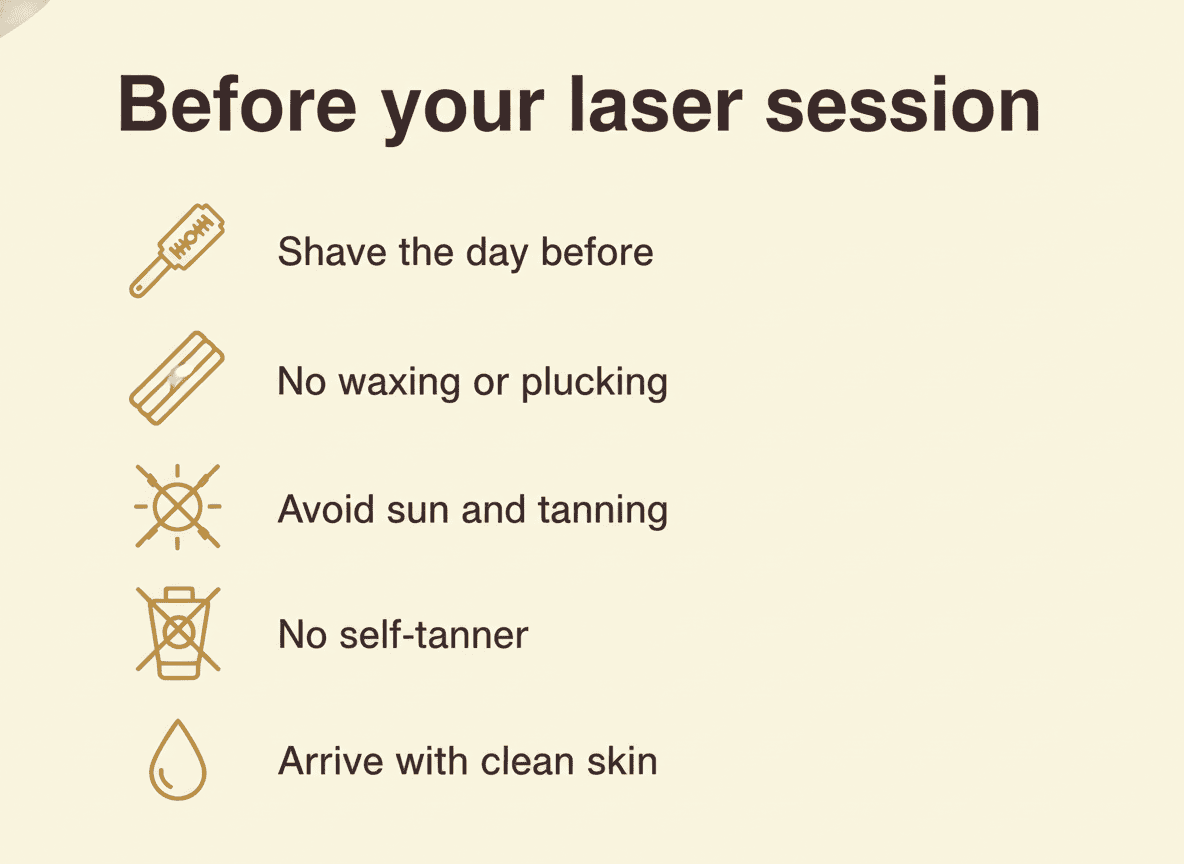
- Shave the area 24 hours before. The hair under the skin stays in place for the laser to target.
- Do not wax, pluck, thread or use epilators. They remove the root the laser needs.
- Avoid sun exposure, tanning beds and self-tanner. Tanned skin raises the risk of burns and pigment changes.
- Arrive with clean skin. Skip lotion, deodorant and makeup on the treatment area.
After each session
- Wear sunscreen on treated skin. It protects against pigment changes.
- Avoid tanning beds for at least six weeks. Elegancy Beauty Bar's laser aftercare guidance recommends this.
- Let treated hairs shed on their own. Do not pull them out.
Elegancy's guide to whether laser hair removal hurts explains what each session feels like.
Should you buy a package of 3, 6 or 10 laser hair removal sessions?
Buy a package that matches the number of sessions you are realistically likely to need. Most people need 6 to 8, so a 6-session package fits most body areas, with extra sessions added later if needed. A 10-session package suits facial hair, hormone-driven hair and dense hair on the back or legs.
Elegancy Beauty Bar's laser hair removal packages
Elegancy Beauty Bar sells laser hair removal as single sessions or as packages of 3, 6 or 10 sessions. The packages are discounted by 20%, 30% and 40%. Current prices for every area and combination are on the laser hair removal page and the price list.
Which package fits which goal
- Single session. Trying laser on a small area, or a yearly maintenance visit.
- 3 sessions. Topping up after a finished course.
- 6 sessions. A full course on most areas, including underarms, bikini and arms.
- 10 sessions. The face, hormone-driven hair, or dense hair on the legs, back and chest.
How do you choose a laser hair removal clinic?
Choose a laser hair removal clinic that tells you which laser it uses, matches the wavelength to your skin type, and does a consultation and patch test before your first full session. Health Canada recommends checking that the person operating the laser has the training and experience to do it safely.
Ask which laser device the clinic uses
In September 2026, Health Canada warned about counterfeit Soprano diode laser hair removal systems in use in some clinics. Health Canada advises checking a device's label against its Medical Devices Active Licence Listing. Ask any clinic which laser it uses before you book. Elegancy Beauty Bar uses the GentleMax Pro and Cynosure Elite+.
Ask for a consultation and patch test
Health Canada's guidelines tell clinics to perform a patch test before a full treatment and to explain realistic outcomes, including the need for several sessions and possible maintenance. A clinic that promises full results in one or two sessions is not telling you the whole story.
Laser hair removal sessions at Elegancy Beauty Bar in Ajax
Elegancy Beauty Bar is a laser and medical spa at 95 Bayly St W, Suite 200, Ajax, Ontario. Its certified beauty therapists offer laser hair removal for all skin tones to clients from Ajax, Pickering, Whitby, Oshawa, Bowmanville and across Durham Region. Elegancy Beauty Bar is rated 4.9 stars across more than 300 reviews.
Your session count starts with a free consultation. A therapist assesses your skin type, hair colour and treatment area, then recommends a realistic number of sessions and the right package.
- Book online: book your free consultation
- Call: 437-333-4124
- Read more: laser hair removal in Ajax
FAQ
Are 6 laser hair removal sessions enough?
Six laser hair removal sessions are enough for many people on areas like the underarms, bikini line and arms. The face, back and hormone-driven hair often need 8 to 10 or more. A few extra single sessions can be added after a 6-session course if some hair remains.
Can you do laser hair removal every 2 weeks?
No. Laser hair removal every 2 weeks does not work faster, because the next set of hairs has not reached its growth phase yet. Wait 4 to 6 weeks on the face and 6 to 10 weeks on the body.
How many laser sessions do you need for the upper lip?
The upper lip usually needs 6 to 10 laser hair removal sessions, spaced 4 to 6 weeks apart. Upper-lip hair is often hormone-driven, so occasional maintenance sessions are common.
How many laser sessions do you need for the underarms?
The underarms usually need 6 to 8 laser hair removal sessions, spaced 6 to 8 weeks apart. Underarm hair is dark and coarse, so it is one of the quickest areas to respond.
Do you have to shave before every laser session?
Yes. Shave the treatment area about 24 hours before every laser hair removal session. Shaving leaves the root in place for the laser while stopping surface hair from burning.
This article is general information and not medical advice. Results vary from person to person. Your number of sessions, settings and suitability for laser hair removal are confirmed at a consultation. If you have a medical condition, are pregnant, or take medication that makes your skin sensitive to light, tell your therapist and speak to your doctor first.
Sources
- American Academy of Dermatology — Laser hair removal: FAQs
- Health Canada — Laser hair removal: safety guidelines for facility owners and operators
- Krasniqi A. et al. — Efficacy of lasers and light sources in long-term hair reduction: a systematic review, Journal of Cosmetic and Laser Therapy, 2022
- Lasers for reduction of unwanted hair in skin of colour: a systematic review and meta-analysis, Journal of the European Academy of Dermatology and Venereology, 2020
- CMAJ — Laser hair removal: no training required?, 2010
- CP24 — Health Canada says this counterfeit device may pose health risks, September 2026